
Traveling toward Ephesus feels different from visiting most ancient sites.
This is not simply archaeology.
This is sacred history layered directly into physical space.
Somewhere along these same roads, the apostle Paul walked, preached, taught, debated, and helped establish one of the most influential early churches in the New Testament world.
And today, we follow that story step by step through the remains of a city that once stood at the center of Roman Asia Minor.
House of the Virgin Mary
Before entering the ancient city itself, the journey begins in the hills above Ephesus where tradition holds that Mary, the mother of Jesus, spent the final years of her life under the care of the apostle John. Whether every historical detail can be fully verified or not, there is something deeply moving about this place.
Pilgrims from around the world arrive quietly here carrying prayers, grief, hope, gratitude, and reflection.
The atmosphere feels different immediately.
Still.
Reverent.
Almost suspended outside normal time.
Places connected to Scripture often create that feeling.
Not because the stones themselves are sacred.
But because they remind us that biblical history unfolded through real people in real places.
Mary was not simply a figure in stained glass.
She lived.
Traveled.
Suffered.
Trusted God through uncertainty.
And standing here reminds me how personal the story of faith has always been.
Upper Gate Entrance
Leaving the hillside behind, the route descends toward the Upper Gate where the ancient city of Ephesus begins unfolding beneath the surrounding hills.
Entering Ephesus through the Upper Gate feels less like visiting ruins and more like stepping into the first century itself.
Marble streets stretch downward between columns, temples, gathering spaces, and homes once filled with ordinary daily life.
Merchants walked here.
Roman officials walked here.
Early Christians walked here.
And somewhere in this same city, the gospel began reshaping lives in ways no one fully understood at the time.
History here does not feel distant.
It feels startlingly close.
Odeon
As the path descends into the city, one of the first major structures to appear is the Odeon.
The Odeon served as both a small theatre and a political meeting place where civic leaders gathered to discuss matters affecting the city.
Standing here reminds me that Ephesus was not only spiritually influential.
It was politically and culturally important as well.
The gospel entered directly into complex public life.
Not separate from society.
But right in the middle of it.
And honestly, that feels incredibly relevant even now.
Curetes Street
From the Odeon, Curetes Street stretches downward through the heart of Ephesus like a corridor connecting nearly every layer of life in the ancient city.
Walking down Curetes Street is one of the most surreal experiences in Ephesus.
Marble columns rise on both sides while carved facades, monuments, fountains, and ruins line the pathway ahead.
Somewhere along these same stones, the apostle Paul almost certainly walked repeatedly during his years ministering here.
That realization changes everything.
Scripture suddenly stops feeling abstract.
Because the places become tangible.
Physical.
Real.
Faith here moved through actual streets filled with commerce, philosophy, idolatry, politics, and daily human struggle.
And somehow the gospel continued spreading anyway.
Terrace Houses
Along the hillside above Curetes Street stand the remains of homes once occupied by some of the wealthiest citizens in Ephesus.
The Terrace Houses reveal what life looked like for the upper classes of Roman Ephesus.
Mosaic floors.
Painted walls.
Indoor plumbing.
Beautiful architecture.
Comfort.
Influence.
And standing here reminds me that the gospel first spread into environments shaped by prosperity and status just as much as poverty and suffering.
Christianity did not begin isolated from culture.
It entered directly into it.
And transformed people one life at a time from within.
Library of Celsus
As the street opens ahead, one of the most recognizable structures of the ancient world suddenly appears.
The Library of Celsus once held thousands of scrolls and stood as a symbol of knowledge, learning, and intellectual achievement throughout the Roman world.
Even today its façade feels breathtaking.
Standing here makes it easier to imagine conversations that once shaped philosophy, culture, politics, and belief across the region.
But what moves me most is remembering that somewhere nearby, Paul was proclaiming a message not centered on information alone—but transformation.
Knowledge matters.
But truth changes lives when it becomes personal.
Great Theatre of Ephesus
Beyond the library, the road widens dramatically toward the largest gathering place in the city.
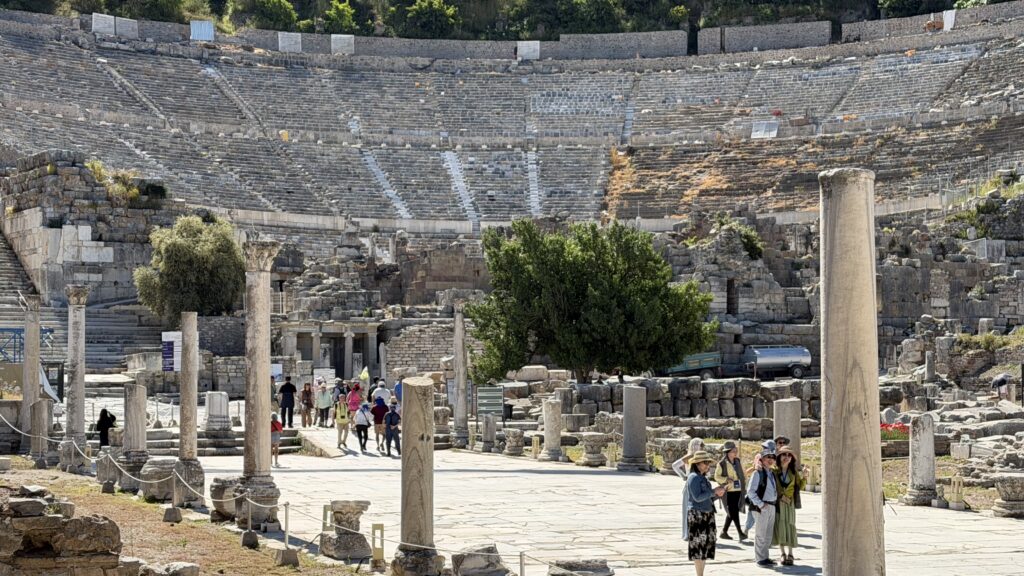
The Great Theatre once held more than twenty thousand people and became the setting for one of the most dramatic moments recorded in the Book of Acts.
Acts 19 describes crowds gathering here shouting:
“Great is Artemis of the Ephesians!”
Standing in this theatre today makes that moment feel incredibly real.
The gospel did not spread quietly.
It challenged systems.
Beliefs.
Economies.
Worldviews.
And yet despite opposition, the message continued moving outward from this city into the wider world.
Temple of Artemis Reflection
Today, very little remains of the Temple of Artemis.
Just scattered stones.
Fragments.
And a single reconstructed column rising above the field where one of the Seven Wonders of the Ancient World once stood.
But centuries ago, this place dominated the identity of Ephesus.
Pilgrims traveled here from across the Roman world to worship Artemis, the goddess closely tied to the city’s economy, spirituality, and cultural pride.
The temple was not simply religious.
It was political.
Economic.
Cultural.
It shaped nearly every part of life in Ephesus.
Which helps explain why the message of Christ created such intense resistance here.
Acts 19 describes silversmiths becoming fearful that Paul’s teaching would reduce devotion to Artemis and threaten the entire system surrounding her worship.
Standing here today creates an incredible contrast.
The temple that once symbolized immense power now exists mostly as ruins.
Yet the gospel preached against its influence continues spreading across the world centuries later.
That realization feels deeply powerful.
Human empires fade.
Cultural movements rise and disappear.
Even wonders of the world eventually collapse.
But truth rooted in Christ continues moving forward generation after generation.
And honestly, standing here among these ruins makes that reality feel unmistakably clear.
Harbor Street Reflection
Leaving the Temple of Artemis behind, the journey returns toward the roads that once connected Ephesus to the wider Mediterranean world.
Roads where travelers carried not only goods and ideas—but eventually the gospel itself far beyond this city.
Harbor Street once carried travelers arriving from across the Roman Empire.
Ships docked nearby bringing goods, ideas, philosophies, religions, and cultures into Ephesus from every direction.
And through roads like this, the gospel spread outward too.
Journeys have always carried more than people.
They carry truth.
Hope.
Influence.
Transformation.
And maybe that’s still true every time we travel today.
Basilica of St. John
Before leaving the region, the journey concludes at one final place deeply connected to the story of the early church.
The Basilica of St. John stands over the traditional burial site of the apostle John, the disciple whom Jesus loved.
Standing here near the end of the day creates a remarkable sense of continuity.
John witnessed the ministry of Jesus personally.
Later he helped care for Mary.
Ministered throughout this region.
And eventually wrote words that still shape the faith of millions today.
It’s remarkable to realize how much of the New Testament story unfolded in places like these.
Not mythological spaces.
Real cities.
Real roads.
Real people.
Real sacrifice.
And real faith carried forward generation after generation.
Closing Reflection — Leaving Ephesus
As the journey through Ephesus comes to an end, what stays with me most is how physical the story of Scripture becomes when you walk the places where it unfolded.
These streets once carried apostles.
These theatres once echoed with opposition to the gospel.
These homes once sheltered early believers.
And yet today, centuries later, the message continues moving forward.
Civilizations rise and fall.
Buildings collapse.
Empires disappear.
But the truth carried through places like Ephesus still changes lives generation after generation.
And standing here reminds me that faith has never simply been believed.
It has always been lived.