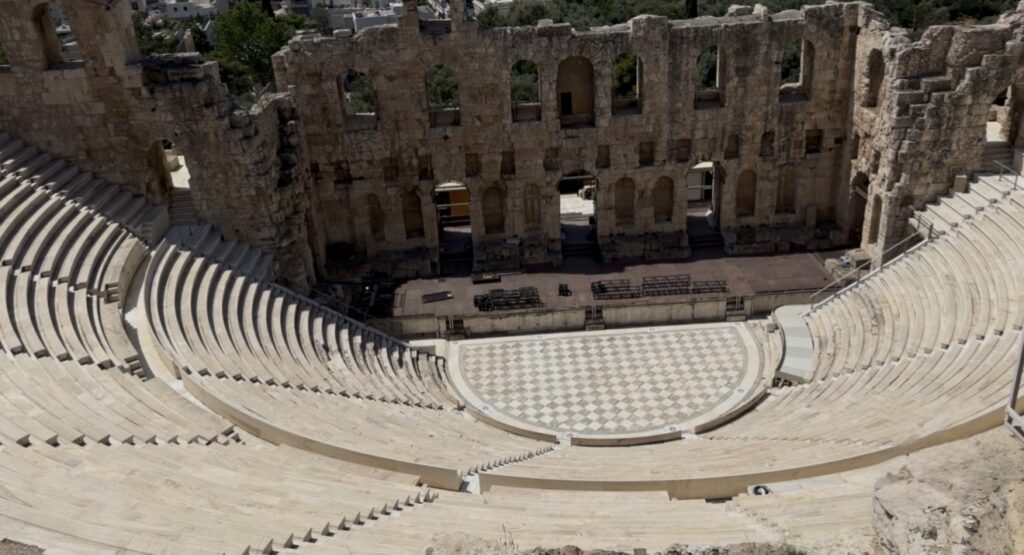
Whoever refreshes others will be refreshed.”

Proverbs 11:25

  • Port of Piraeus

    Arriving in Athens feels different from almost every other stop along this journey.

    This city is not simply historic.

    It is foundational.

    For centuries, ideas born here shaped philosophy, democracy, rhetoric, art, politics, and intellectual thought throughout the Western world.

    But Athens carries another layer of significance for this journey.

    This is where the apostle Paul stood before philosophers and proclaimed the gospel in the middle of one of the most intellectually influential cultures in history.

    And today, we begin exploring it from the upper deck of a Hop-On/Hop-Off bus that slowly introduces the city one district at a time.


    As the bus leaves the port of Piraeus, modern Athens gradually begins unfolding beyond the harbor.

    Apartment buildings rise beside ancient ruins.

    Scooters weave through streets that once carried philosophers, merchants, and Roman officials.

    Athens feels layered.

    Not divided between ancient and modern.

    But built from both at the same time.


    Panoramic Acropolis View

    One of the advantages of the HOHO route is perspective.

    Instead of immediately standing inside the history, you first watch the city unfold around it.

    And eventually, above everything else, the Acropolis begins appearing over the skyline.

    Few landmarks in the world dominate a city the way this one does.

    For nearly twenty-five centuries, these structures have overlooked Athens while generations came and went beneath them.

    Standing in their shadow reminds you how temporary human life really is compared to the long story of civilization itself.


    Toward the Acropolis District

    As the route approaches the Acropolis district, the atmosphere changes.

    Tourists fill the sidewalks.

    Street musicians appear near cafés.

    And the energy of the city begins concentrating around the ancient center above it all.


    The Parthenon Reflection

    The Parthenon was originally built as a temple dedicated to Athena, the patron goddess of Athens.

    But over time it became much more than a religious structure.

    It became a symbol.

    Of philosophy.

    Of Greek civilization.

    Of human achievement.

    And honestly, standing near it makes complete sense of why people throughout history became captivated by Athens.

    The scale alone inspires awe.

    But what impacts me most is its endurance.

    Empires rose and disappeared after these columns were built.

    Wars reshaped continents.

    Cultures transformed.

    And still the Parthenon remains standing above the city.

    Places like this remind me how deeply ideas shape generations.


    Mars Hill (Acts 17)

    It was here on Mars Hill that the apostle Paul addressed the philosophers of Athens in Acts chapter 17.

    Standing in this area changes how you hear those verses.

    Because Paul was not speaking into a vacuum.

    He was speaking into one of the most intellectually advanced societies in the ancient world.

    Acts records him saying:

    “Men of Athens, I see that in every way you are very religious.”

    What strikes me most is how Paul approached the conversation.

    Not with hostility.

    Not with fear.

    But with understanding.

    He observed their culture first.

    Then pointed them toward truth.

    And honestly, that approach still feels incredibly relevant today.

    Faith does not fear questions.

    It enters directly into them.

    Temple of Olympian Zeus

    The Temple of Olympian Zeus once stood as one of the largest temples in the ancient world.

    Though only portions remain today, the scale still feels overwhelming.

    Standing beside structures like this reminds me how humanity has always searched for transcendence.

    People have always built monuments to meaning.

    Always searched for something larger than themselves.

    And perhaps that universal search explains why the gospel resonated so powerfully across cultures throughout history.


    Modern Athens Reflection

    Leaving the ancient district behind, the route moves through neighborhoods where modern life continues beneath the weight of thousands of years of history.


    What fascinates me about Athens is not simply the ruins.

    It’s the coexistence.

    Ancient columns stand beside apartment buildings.

    Street cafés overlook archaeological sites.

    Daily life continues directly beside civilization’s foundations.

    And honestly, maybe that mirrors life itself.

    The past is never completely separate from the present.

    It continues shaping how we see, think, believe, and move forward every day.


    Closing Reflection — Return to Ship


    As the bus gradually circles back toward the port, the Acropolis slowly fades farther into the background behind the city skyline.
    As Athens disappears behind the harbor, I keep thinking about Paul’s words spoken here centuries ago:

    “In Him we live and move and have our being.”

    Standing in the city where those words were first proclaimed makes them feel remarkably alive even now.

    Because Athens reminds us that humanity has always searched for truth.

    And the gospel continues entering that search generation after generation.

    Maybe that’s why journeys like this matter.

    Not because they simply show us new places.

    But because they help us see eternal truths from new perspectives.
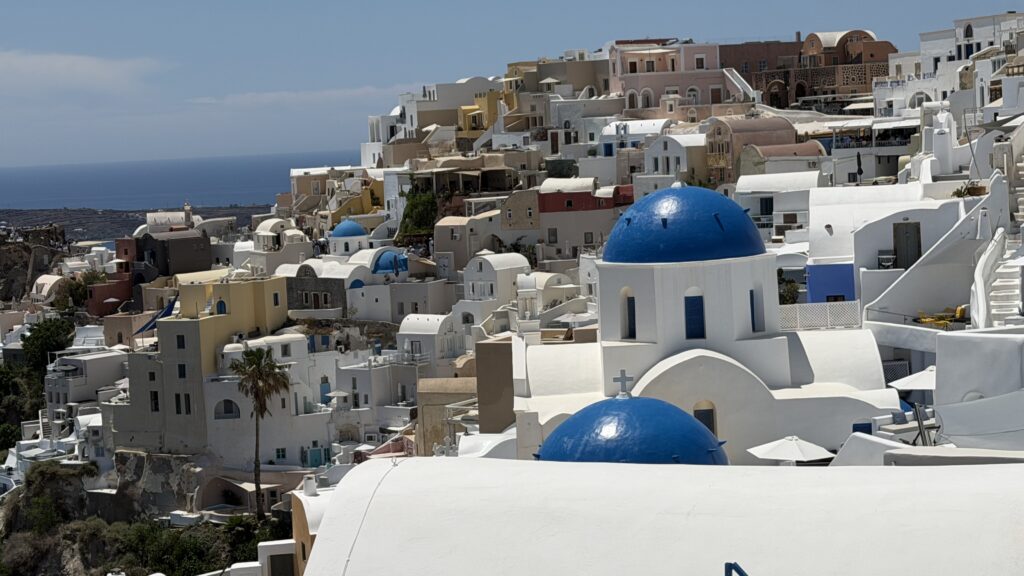
  • As our ship approaches Santorini, it’s hard to believe this island was shaped by one of the most powerful volcanic eruptions in human history.

    More than 3,500 years ago, a massive eruption collapsed the center of the island, leaving behind the dramatic crescent-shaped cliffs that make Santorini one of the most recognizable destinations in the world.

    Today, those towering cliffs rise nearly a thousand feet above the Aegean Sea.

    From the water, the whitewashed villages almost appear to float above the ocean.

    It’s a sight that reminds us how beauty can emerge from even the most violent moments in history.

    Sometimes the places that have been broken the most become the places that display the greatest beauty.

    And Santorini may be one of the finest examples of that truth anywhere on earth.


    Transition to Fira

    The journey from the harbor to Fira is an experience all by itself.

    Whether arriving by cable car, shuttle, or winding road, every turn reveals another breathtaking view of the caldera below.

    As you climb higher, the perspective changes.

    The ships become smaller.

    The sea stretches farther.

    And the horizon seems endless.

    It’s a reminder that sometimes we need a change in perspective to truly appreciate where we are.


    Stop 1 — Fira

    Welcome to Fira, the capital of Santorini.

    Perched dramatically along the edge of the caldera, Fira combines stunning views, charming architecture, and the energy of a vibrant island community.

    The narrow pathways wind between whitewashed homes, blue-domed churches, boutique shops, cafés, and restaurants that seem suspended between sky and sea.

    Every corner feels like a postcard.

    Every overlook offers a new perspective.

    As you walk through Fira, it’s easy to understand why millions of travelers dream of visiting this island.

    But beyond the scenery lies a deeper lesson.

    The people who built this town chose to construct their homes on the edge of uncertainty.

    Clinging to cliffs.

    Facing the sea.

    Living with both beauty and risk.

    Life often feels that way too.

    We rarely receive guarantees.

    Yet some of life’s most meaningful experiences are found when we step forward despite uncertainty.


    Caldera Overlook Reflection

    Standing here overlooking the caldera, the scale of nature becomes impossible to ignore.

    The volcanic crater stretches for miles.

    The deep blue water fills what was once the center of an island.

    And all around us are reminders that this landscape was forever changed.

    Yet today people come from every corner of the world to see it.

    The very event that destroyed the island helped create the beauty that now defines it.

    There is a lesson hidden in that.

    Our greatest disappointments do not always have the final word.

    Sometimes they become part of a larger story we cannot yet see.


    Stop 2 — Oia

    Leaving Fira, the road winds north toward one of the most famous villages in the world.

    The drive itself is spectacular.

    White villages cling to ridgelines.

    Church steeples punctuate the skyline.

    And the sea appears on both sides of the island.

    Few places offer scenery quite like this.

    As Oia comes into view, it’s easy to see why artists, photographers, and dreamers have been drawn here for generations.Welcome to Oia.

    Pronounced “EE-ah,” this village is often considered the crown jewel of Santorini.

    The whitewashed buildings cascade down the cliffs toward the sea below.

    Blue-domed churches rise above the rooftops.

    Narrow pathways weave through shops, galleries, and hidden terraces.

    Nearly every turn offers another incredible photograph.

    But Oia is more than beautiful architecture.

    It’s a village with resilience.

    Following a devastating earthquake in 1956, much of Oia had to be rebuilt.

    What visitors see today is the result of determination, vision, and perseverance.

    The lesson is clear.

    Setbacks are not always endings.

    Sometimes they become opportunities to rebuild something even stronger.


    Blue Dome Churches

    The iconic blue domes of Santorini have become symbols recognized around the world.

    Against the brilliant white walls and deep blue sky, they create one of travel’s most memorable images.

    For centuries these churches have served as places of worship, gathering, and community.

    Their presence reminds us that while scenery may attract visitors, faith, hope, and relationships are what sustain communities.

    Beautiful views inspire us.

    But meaningful lives are built on deeper foundations.


    Oia Castle Sunset Viewpoint

    One of the most famous viewpoints in all of Greece is found at the ruins of Oia Castle.

    People gather here from around the world to watch the sun sink into the Aegean Sea.

    As the light changes, the white buildings glow gold, orange, and pink.

    The sea reflects every color.

    And for a few moments, time seems to slow down.

    Travel has a way of creating moments like this.

    Moments where schedules disappear.

    Phones are forgotten.

    And we simply appreciate the gift of being present.

    Perhaps that’s one of the greatest benefits of a journey.

    Not just seeing new places.

    But learning to truly see again.


    Closing Reflection

    As our day in Santorini comes to an end, it’s easy to understand why this island captures the imagination of so many people.

    Its beauty is undeniable.

    Its history is remarkable.

    Its views are unforgettable.

    But perhaps its greatest lesson is this:

    Some of the most beautiful things in life emerge after seasons of upheaval.

    Santorini exists because a volcano changed everything.

    Yet today, millions come here to witness the beauty that followed.

    That’s a message worth remembering long after the island disappears beyond the horizon.

    Thanks for joining us in Santorini.

    Until the next stop on the journey, keep exploring, keep learning, and keep discovering the beauty that can emerge from every season of life.

  • As the ship approaches Dubrovnik, the Old City slowly rises from the Adriatic like something preserved outside of time itself.

    Massive stone walls stretch around red-tiled rooftops that have guarded this coastline for centuries.

    From the water, Dubrovnik feels almost unreal.

    Not because it looks artificial.

    But because it looks enduring.

    Empires rose and fell around this city.

    Wars came and went.

    Trade routes shifted.

    And still these walls remain standing beside the sea.

    There’s something deeply moving about places that survive history rather than simply witnessing it.


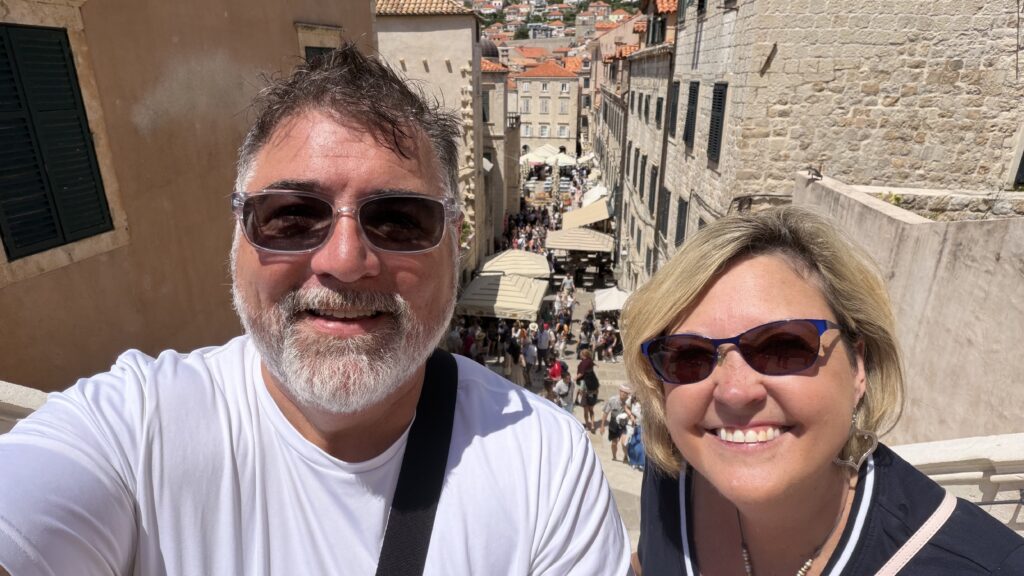
    Pile Gate

    Leaving the harbor behind, the route gradually climbs toward Pile Gate, the traditional entrance into Dubrovnik’s Old Town.

    For generations, travelers crossed through this same entrance before stepping into one of the most carefully protected cities in the Mediterranean world.

    Journeys often begin with thresholds like this.

    Quiet transitions that separate one experience from another.

    Passing through Pile Gate feels like stepping across centuries in a single moment.

    Outside the walls, modern Croatia continues moving forward with traffic, buses, and cruise passengers.

    Inside the walls, time seems to slow immediately.

    Stone streets narrow.

    Footsteps echo.

    Shadows move across buildings shaped hundreds of years ago.

    Dubrovnik doesn’t simply preserve history.

    It surrounds you with it.

    And maybe that’s why entering this city feels emotional in a way photographs never fully capture.


    Stradun Reflection

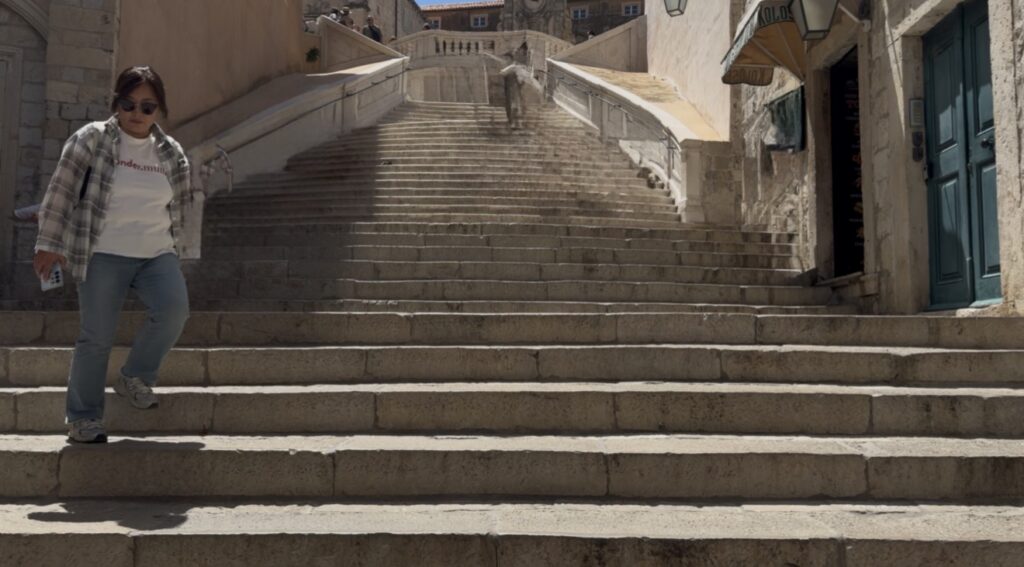
    As the city opens ahead, Stradun stretches through the center of Dubrovnik like a corridor connecting centuries together.

    Walking along Stradun reveals the heartbeat of Dubrovnik.

    For generations this street connected merchants, sailors, diplomats, travelers, and citizens living inside the protection of the walls surrounding them.

    And even today, the city still feels deeply human.

    Laundry hangs between buildings.

    Conversations drift through narrow alleys.

    Church bells echo above cafés and stone walkways.

    Places like this remind me that history was never abstract.

    It was daily life.

    Ordinary people waking up, working, praying, struggling, celebrating, and continuing forward one day at a time.

    And somehow that realization makes the city feel even more meaningful.


    Onofrio’s Fountain


    At the western end of Stradun stands one of the city’s most important historic gathering places.

    Onofrio’s Fountain once supplied fresh water to the entire city through an engineering system that was remarkably advanced for its time.

    In fortified cities like Dubrovnik, water meant survival.

    And standing here reminds me how often unseen systems support visible strength.

    That’s true historically.

    And spiritually too.

    The things sustaining us most deeply are often the things people around us never fully see.


    Rector’s Palace


    Continuing east through the city, the route gradually approaches the administrative center of the former Republic of Ragusa.

    The Rector’s Palace reflects a different kind of power than many historic cities display.

    Dubrovnik survived not primarily through conquest, but through diplomacy, wisdom, and careful leadership.

    For centuries the republic balanced larger empires around it while preserving remarkable independence.

    Standing here makes me think about how strength is not always loud.

    Sometimes wisdom protects more effectively than force.

    And honestly, that truth feels increasingly important in the world we live in now.


    Dubrovnik Cathedral


    Just beyond the palace, the cathedral rises quietly among the stone streets surrounding it.

    Churches like this often become anchors for cities across generations.

    Empires change.

    Leadership changes.

    Economies rise and fall.

    But spaces of worship continue gathering people searching for hope, meaning, forgiveness, and peace.

    There’s something comforting about that continuity.

    Especially during seasons of transition.


    Dubrovnik City Walls

    Walking the city walls changes everything.

    Suddenly the Adriatic stretches endlessly on one side while the rooftops of Dubrovnik fill the city below on the other.

    Perspective changes from up here.

    The streets that once felt crowded now look small.

    The city that felt enclosed now feels connected to the wider sea beyond it.

    And maybe that’s what perspective always does.

    It doesn’t remove complexity.

    It simply places it inside something larger.


    Adriatic Reflection Point

    From the cathedral square, the path begins rising toward one of the most extraordinary walking routes anywhere in Europe.


    As the walk continues along the outer edge of the walls, the Adriatic opens wider toward the horizon beyond the city.

    Standing above the Adriatic beside these ancient walls, it becomes clear why Dubrovnik mattered so much to travelers and empires alike.

    Position shaped destiny here.

    Trade routes.

    Protection.

    Influence.

    Connection.

    All of it depended on geography.

    And sometimes our own lives work similarly.

    Where we stand affects how we see.

    How we think.

    How we move forward.

    That’s one reason travel can become transformational.

    It changes position.

    And changed position often changes perspective.


    Sunset Over Dubrovnik


    As evening approaches, sunlight begins softening across the stone walls and rooftops of the Old City.

    Watching the light fade across Dubrovnik feels almost cinematic.

    The stone glows warm gold before slowly cooling into evening shadows.

    The Adriatic darkens into deep blue beyond the harbor.

    And gradually the city begins becoming quieter.

    Psalm 121 says,

    “The Lord will watch over your coming and going both now and forevermore.”

    Standing here above the city walls, those words feel especially meaningful.

    Because places built for protection eventually remind us that true security has always come from something deeper than stone.


    Closing Reflection 

    As the ship pulls away from Dubrovnik, the walls slowly begin shrinking back into the coastline behind us.

    And what stays with me most is not simply the beauty of the city.

    It’s the endurance.

    The resilience.

    The reminder that some places survive because they learned how to balance strength with wisdom across generations.

    Maybe sabbatical is teaching something similar.

    Not simply how to rest.

    But how to endure wisely.

    And perhaps that’s one of the most valuable journeys a person can take.

  • Entering Mykonos Harbor

    As the ship approaches Mykonos, the island slowly comes into focus through bright white buildings, blue water, and sunlight reflecting across the harbor.

    Compared to some of the larger Mediterranean cities, Mykonos feels smaller, more intimate, more relaxed.

    And yet islands like this have welcomed travelers for centuries.

    Sailors, merchants, fishermen, pilgrims, and explorers all passed through waters like these long before cruise ships ever appeared on the horizon.

    What makes Mykonos feel unique isn’t just its beauty.

    It’s the atmosphere.

    There’s a lightness here.

    A slower rhythm.

    A sense that the island itself is inviting you to breathe differently.


    Old Port Waterfront

    Leaving the harbor behind, the waterfront curves gently along the Old Port where fishing boats, cafés, and narrow alleyways begin blending together.

    The sea is never far away here.

    You hear it constantly.

    See it between buildings.

    Feel it in the wind moving through the streets.

    Island life always stays connected to the water.

    Walking along the Old Port reveals the quieter side of Mykonos before the crowds fully fill the streets later in the day.

    Fishing boats drift beside cafés where conversations stretch longer than schedules.

    And honestly, that feels refreshing.

    Sabbatical has been teaching me how much of normal life is driven by urgency.

    Deadlines.

    Notifications.

    Appointments.

    Constant movement.

    But places like this operate differently.

    People linger.

    They sit longer.

    They notice more.

    And maybe that’s one reason islands have always drawn travelers searching for rest.

    Not because nothing happens here.

    But because life unfolds at a more human pace.


    Chora Walking Reflection

    From the harbor, the streets narrow quickly into the winding pathways that define Mykonos Town.

    The bright white walls reflect sunlight into every corner while the alleyways twist unpredictably in every direction.

    Originally, these streets were designed to confuse pirates centuries ago.

    Today they simply encourage visitors to slow down and wander.

    Walking through Chora feels less like navigating a city and more like discovering it one turn at a time.

    There’s no perfect straight-line route here.

    And maybe that’s part of the charm.

    Journeys often become richer when we stop trying to control every direction.

    Some of the most meaningful moments happen unexpectedly.

    A hidden courtyard.

    A quiet church.

    A conversation.

    A view around a corner you didn’t plan to turn.

    Mykonos reminds me that wandering is not always wasted movement.

    Sometimes it’s how discovery happens.

    Mykonos Windmills

    As the streets gradually rise above the harbor, the famous windmills begin appearing against the skyline.


    The windmills overlooking Mykonos once powered the island’s grain production and stood at the center of daily life here for generations.

    Today they’ve become symbols of the island itself.

    But standing here in person makes it easier to imagine the ordinary labor that once shaped life around them.

    Places like this remind me that beauty and work are not opposites.

    The same structures tourists now photograph once existed simply to serve the needs of everyday people.

    And somehow that makes them even more meaningful.

    Little Venice Waterfront

    Descending slightly toward the shoreline brings the sea back into view between buildings as cafés and balconies begin extending directly over the water.

    Little Venice feels almost suspended between land and sea.

    Homes and cafés sit so close to the water that waves seem to arrive directly beneath the balconies.

    Merchants once used buildings like these to move goods directly from boats into the city itself.

    Today the atmosphere feels softer.

    More reflective.

    More romantic.

    But the connection between this island and the sea remains exactly the same.

    Journeys have always shaped life here.


    Panagia Paraportiani

    Just beyond the waterfront stands one of the most recognizable churches in the Cyclades.

    The Church of Panagia Paraportiani almost looks sculpted from the hillside rather than constructed upon it.

    Built gradually over centuries, it reflects the quiet persistence of faith across generations of island life.

    Small churches like this often tell deeper stories than large cathedrals.

    Because they remind us that faithfulness usually grows quietly.

    Not dramatically.

    Not publicly.

    But steadily over time.

    And honestly, there’s something beautiful about that kind of consistency.


    Sunset Harbor Reflection

    As evening approaches, the light across the harbor begins changing again.

    White walls soften into gold.

    The sea darkens into deeper shades of blue.

    And slowly the island begins shifting into evening rhythm.Watching the sunset over Mykonos feels peaceful in a different way than Santorini.

    Less dramatic.

    More intimate.

    The beauty here isn’t overwhelming.

    It’s calming.

    And maybe that’s what makes this island memorable.

    Not spectacle.

    Stillness.

    Psalm 46 says,

    “Be still, and know that I am God.”

    Moments like this remind me how difficult stillness can be—and how necessary it is at the same time.

    Closing Reflection — Return Toward Ship

    As the harbor lights begin reflecting across the water, Mykonos slowly starts fading back into the evening behind the ship.

    And what stays with me most isn’t necessarily the famous views.

    It’s the pace.

    The simplicity.

    The reminder that life doesn’t always need to move faster to become more meaningful.

    Sometimes slowing down is what allows us to see clearly again.

    And maybe that’s one of the quiet gifts sabbatical is meant to give.

  • Harbor Arrival — Mandraki Harbor 

    As the ship approaches Rhodes, the harbor opens into one of the most historic shorelines in the Mediterranean. For centuries, this island stood at the crossroads between Europe, the Middle East, and North Africa, shaping trade routes and defending empires.

    Rhodes is remembered as the stronghold of the Knights Hospitaller, who ruled here from the fourteenth century until the Ottoman conquest in 1522. Even today, the walls of the medieval city still reflect their presence.

    Arriving here feels like stepping into a fortress shaped by faith, conflict, and endurance across generations.


    Mandraki Harbor Windmills

    Along the harbor’s edge stand the windmill towers and the narrow entrance where ancient ships once passed into the protected port.

    Tradition places the legendary Colossus of Rhodes somewhere near this entrance, reminding visitors that this island once held one of the Seven Wonders of the Ancient World.

    The windmills of Mandraki Harbor once helped support the commercial life of the island when Rhodes stood at the center of Mediterranean trade.

    Today they stand as quiet markers of continuity between ancient navigation and modern travel.

    Journeys across the sea have always shaped cities like this.


    Street of the Knights

    Passing through the gates of the Old Town feels like stepping across centuries in a single moment.

    Rhodes preserves one of the most complete medieval cities in Europe, protected by walls built and strengthened by the Knights of Saint John.

    The Street of the Knights remains one of the best-preserved medieval streets anywhere in Europe, lined with stone residences built for the different national groups of the Knights Hospitaller during the fourteenth century. 


    Walking here feels less like visiting history and more like entering it.

    The same stones that supported knights preparing for journeys and battles still carry visitors today.

    Palace of the Grand Master

    At the end of the street rises one of the most important buildings in the medieval world of Rhodes.


    The Palace of the Grand Master served as the administrative center of the Knights Hospitaller during their rule of the island after they established control in 1310. 

    From here decisions were made that shaped the defense of the eastern Mediterranean for generations.

    Standing inside these walls reminds me how leadership once centered around conviction as much as strategy.


    Knights’ Hospital Courtyard

    Nearby stands the former hospital of the Knights, now preserved as part of the city’s archaeological museum complex.

    This hospital once cared for pilgrims and travelers arriving from across the Mediterranean world.

    Places like this remind me that hospitality has always been part of the story of faith-filled journeys.

    Even in fortified cities, compassion remained essential.

    Suleiman Mosque Area


    Continuing south through the Old Town, the architecture begins reflecting later centuries of Ottoman influence layered onto the earlier medieval city.


    Rhodes carries the marks of many civilizations that passed through here—Byzantine, Crusader, Ottoman, and modern Greek.

    Cities shaped by so many layers remind me how history rarely moves in straight lines.

    Instead, it builds one generation at a time.

    Harbor Overlook Reflection

    Leaving the medieval streets behind, the path gradually opens again toward the waterfront where the walk first began.

    Looking back toward the harbor from outside the city walls, it becomes clear why Rhodes mattered so much to travelers and empires alike.

    Position shaped destiny here.

    And sometimes where we stand shapes how we understand where we’re going next.

    Closing Reflection — Return to Ship

    Before leaving Rhodes, I keep thinking about how this island stood for centuries as a place of defense, refuge, and faith at the edge of changing empires.

    Psalm 27 says,

    “The Lord is my light and my salvation—whom shall I fear?”

    Standing inside a city once built for protection makes those words feel especially strong.

    Journeys like this remind me that courage has always been part of walking forward in faith.

  • Adriatic Sail Into Zadar

    As the ship approaches Zadar, the coastline feels quieter than many of the other ports along the Adriatic.

    There are no towering cliffs like Santorini.

    No massive walls rising dramatically from the sea like Dubrovnik.

    Instead, Zadar welcomes visitors slowly.

    Stone streets.

    Bell towers.

    Roman ruins.

    Open waterfront promenades.

    And a rhythm shaped more by everyday coastal life than spectacle.

    But sometimes quieter places reveal themselves more deeply over time.

    And honestly, Zadar feels like that kind of city.


    Walk Toward the Land Gate

    Leaving the harbor area behind, the route moves toward the historic Land Gate, the traditional entrance into the Old Town.

    For centuries travelers crossed through this same gateway while entering one of the Adriatic’s most important Venetian coastal cities.

    Journeys often begin with simple transitions like this.

    A gate.

    A bridge.

    A shoreline.

    And suddenly the atmosphere changes.


    Land Gate Reflection

    Passing through the Land Gate feels like stepping into layers of history quietly stacked together.

    Venetian architecture blends with Roman foundations.

    Church towers rise beside cafés.

    Modern life continues naturally among structures that have stood here for centuries.

    What strikes me most about places like Zadar is how unforced the history feels.

    Nothing here seems staged.

    The city simply continues living beside its own past.


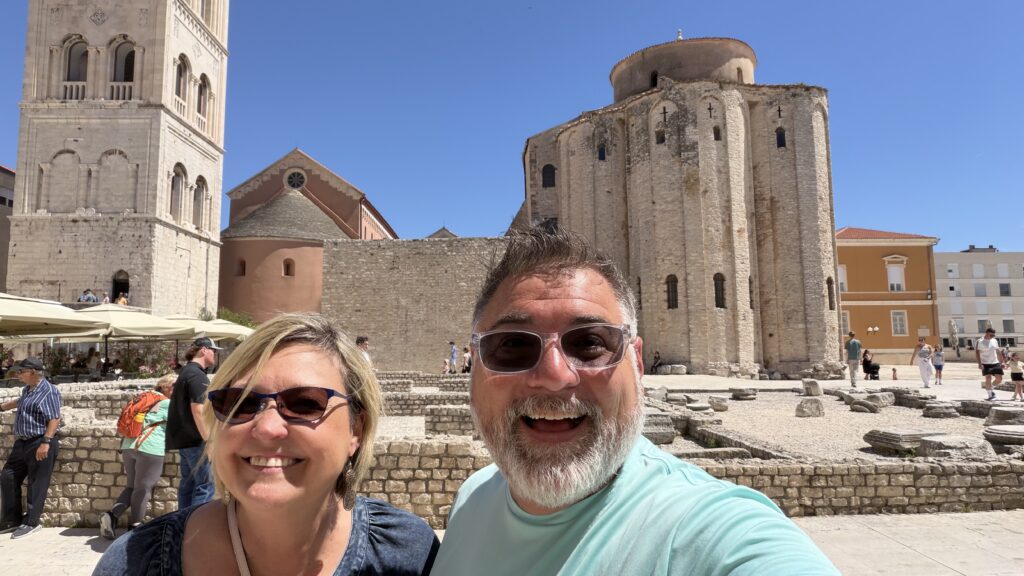
    Roman Forum

    From the gate, the streets gradually open into one of the oldest public spaces in the city.

    The Roman Forum dates back nearly two thousand years and once served as the civic center of ancient Zadar.

    Standing among these ruins reminds me how many ordinary lives unfolded here long before modern travelers ever arrived.

    Conversations.

    Markets.

    Politics.

    Worship.

    Daily routines repeated generation after generation.

    History is often closer than we realize.

    Not distant.

    Not abstract.

    But layered directly beneath the places we still walk today.


    Transition — Walk Toward St. Donatus


    Church of St. Donatus

    Beside the forum stands one of the most recognizable landmarks in Croatia.


    The circular Church of St. Donatus has stood here since the ninth century and remains one of the most important examples of early medieval architecture along the Adriatic.

    Its shape immediately captures your attention.

    But what feels even more remarkable is its endurance.

    Empires changed around it.

    Borders shifted.

    Wars came and went.

    And still this church remains standing beside the forum after more than a thousand years.

    Faith communities often outlast the eras surrounding them.

    And maybe that quiet consistency is part of their strength.


    Transition — Walk Toward Cathedral of St. Anastasia

    Just beyond St. Donatus rises the cathedral bell tower overlooking the Old Town.


    Cathedral of St. Anastasia

    The Cathedral of St. Anastasia reflects centuries of worship woven into the life of this city.

    Places like this remind me how belief often becomes part of a community’s foundation rather than something separate from it.

    People prayed here through prosperity and hardship.

    Through uncertainty and peace.

    Generation after generation continuing forward together.

    There’s something deeply stabilizing about places that hold memory like that.


    Transition — Walk Toward the Waterfront

    Leaving the historic center behind, the streets gradually open toward the sea once again.

    The Sea Organ

    The Sea Organ may be one of the most unique places anywhere along the Adriatic coast.

    Hidden beneath the waterfront steps are pipes designed to transform waves into music.

    No performance schedule.

    No musician visible.

    Only wind.

    Water.

    And sound created naturally by the movement of the sea itself.

    Standing here reminds me how creation often communicates in ways more powerful than words.

    Sometimes beauty doesn’t need explanation.

    It simply needs attention.


    Walk Toward the Sun Salutation

    Just beyond the Sea Organ stands another modern installation shaped by interaction with nature itself.


    Greeting to the Sun

    The Sun Salutation gathers solar energy during the day before transforming it into patterns of light across the waterfront after sunset.

    What fascinates me about Zadar is how naturally ancient history and modern creativity exist together here.

    Roman ruins stand beside contemporary art.

    Medieval churches overlook innovative installations.

    And somehow none of it feels disconnected.

    Instead, the city feels layered.

    Alive.

    Still evolving.


    Transition — Sunset Along the Adriatic


    Stop 7 — Adriatic Sunset Reflection

    As evening approaches, the light across the Adriatic begins softening while people gather along the waterfront waiting for sunset.
    Alfred Hitchcock once reportedly called Zadar’s sunset the most beautiful in the world.

    Standing here as the sun lowers into the Adriatic, it becomes easier to understand why.

    The horizon stretches endlessly.

    The Sea Organ echoes softly behind you.

    And gradually the entire waterfront becomes quieter.

    Psalm 19 says,

    “The heavens declare the glory of God; the skies proclaim the work of His hands.”

    Moments like this make those words feel immediate rather than symbolic.

    Creation has a way of slowing us down long enough to notice what matters most.

    Closing Reflection — Return Toward Ship

    As the harbor lights begin reflecting across the water, Zadar slowly fades into evening behind the ship.

    And what stays with me most about this city is not dramatic spectacle.

    It’s balance.

    The balance between history and modern life.

    Between creativity and stillness.

    Between movement and reflection.

    Maybe that’s part of what sabbatical is teaching too.

    Not simply how to stop.

    But how to live with better rhythm moving forward.

  • Traveling toward Ephesus feels different from visiting most ancient sites.

    This is not simply archaeology.

    This is sacred history layered directly into physical space.

    Somewhere along these same roads, the apostle Paul walked, preached, taught, debated, and helped establish one of the most influential early churches in the New Testament world.

    And today, we follow that story step by step through the remains of a city that once stood at the center of Roman Asia Minor.


    House of the Virgin Mary

    Before entering the ancient city itself, the journey begins in the hills above Ephesus where tradition holds that Mary, the mother of Jesus, spent the final years of her life under the care of the apostle John. Whether every historical detail can be fully verified or not, there is something deeply moving about this place.

    Pilgrims from around the world arrive quietly here carrying prayers, grief, hope, gratitude, and reflection.

    The atmosphere feels different immediately.

    Still.

    Reverent.

    Almost suspended outside normal time.

    Places connected to Scripture often create that feeling.

    Not because the stones themselves are sacred.

    But because they remind us that biblical history unfolded through real people in real places.

    Mary was not simply a figure in stained glass.

    She lived.

    Traveled.

    Suffered.

    Trusted God through uncertainty.

    And standing here reminds me how personal the story of faith has always been.


    Upper Gate Entrance

    Leaving the hillside behind, the route descends toward the Upper Gate where the ancient city of Ephesus begins unfolding beneath the surrounding hills.

    Entering Ephesus through the Upper Gate feels less like visiting ruins and more like stepping into the first century itself.

    Marble streets stretch downward between columns, temples, gathering spaces, and homes once filled with ordinary daily life.

    Merchants walked here.

    Roman officials walked here.

    Early Christians walked here.

    And somewhere in this same city, the gospel began reshaping lives in ways no one fully understood at the time.

    History here does not feel distant.

    It feels startlingly close.


    Odeon

    As the path descends into the city, one of the first major structures to appear is the Odeon.


    The Odeon served as both a small theatre and a political meeting place where civic leaders gathered to discuss matters affecting the city.

    Standing here reminds me that Ephesus was not only spiritually influential.

    It was politically and culturally important as well.

    The gospel entered directly into complex public life.

    Not separate from society.

    But right in the middle of it.

    And honestly, that feels incredibly relevant even now.

    Curetes Street

    From the Odeon, Curetes Street stretches downward through the heart of Ephesus like a corridor connecting nearly every layer of life in the ancient city.

    Walking down Curetes Street is one of the most surreal experiences in Ephesus.

    Marble columns rise on both sides while carved facades, monuments, fountains, and ruins line the pathway ahead.

    Somewhere along these same stones, the apostle Paul almost certainly walked repeatedly during his years ministering here.

    That realization changes everything.

    Scripture suddenly stops feeling abstract.

    Because the places become tangible.

    Physical.

    Real.

    Faith here moved through actual streets filled with commerce, philosophy, idolatry, politics, and daily human struggle.

    And somehow the gospel continued spreading anyway.


    Terrace Houses

    Along the hillside above Curetes Street stand the remains of homes once occupied by some of the wealthiest citizens in Ephesus.

    The Terrace Houses reveal what life looked like for the upper classes of Roman Ephesus.

    Mosaic floors.

    Painted walls.

    Indoor plumbing.

    Beautiful architecture.

    Comfort.

    Influence.

    And standing here reminds me that the gospel first spread into environments shaped by prosperity and status just as much as poverty and suffering.

    Christianity did not begin isolated from culture.

    It entered directly into it.

    And transformed people one life at a time from within.


    Library of Celsus

    As the street opens ahead, one of the most recognizable structures of the ancient world suddenly appears.

    The Library of Celsus once held thousands of scrolls and stood as a symbol of knowledge, learning, and intellectual achievement throughout the Roman world.

    Even today its façade feels breathtaking.

    Standing here makes it easier to imagine conversations that once shaped philosophy, culture, politics, and belief across the region.

    But what moves me most is remembering that somewhere nearby, Paul was proclaiming a message not centered on information alone—but transformation.

    Knowledge matters.

    But truth changes lives when it becomes personal.


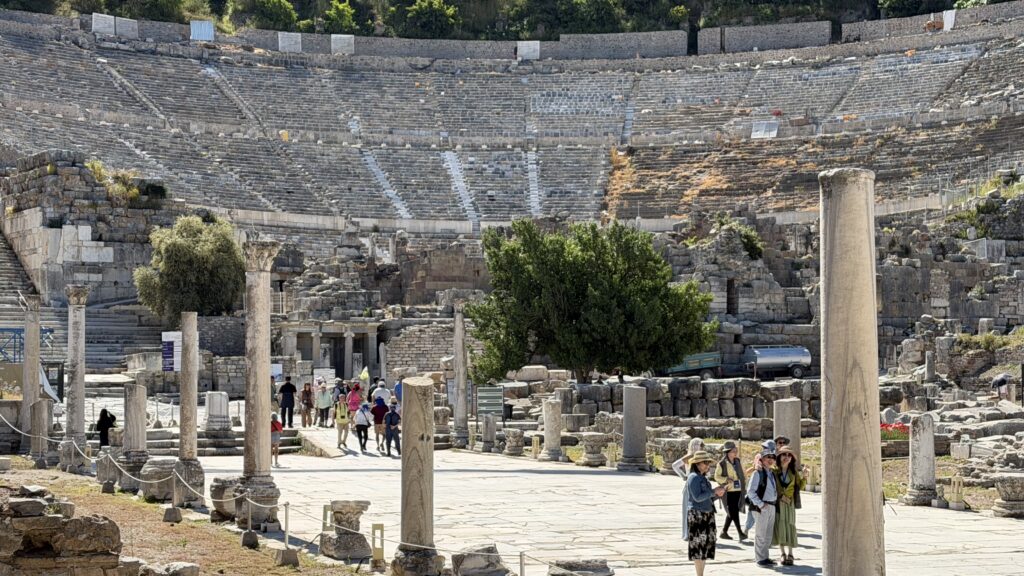
    Great Theatre of Ephesus

    Beyond the library, the road widens dramatically toward the largest gathering place in the city.

    The Great Theatre once held more than twenty thousand people and became the setting for one of the most dramatic moments recorded in the Book of Acts.

    Acts 19 describes crowds gathering here shouting:

    “Great is Artemis of the Ephesians!”

    Standing in this theatre today makes that moment feel incredibly real.

    The gospel did not spread quietly.

    It challenged systems.

    Beliefs.

    Economies.

    Worldviews.

    And yet despite opposition, the message continued moving outward from this city into the wider world.

    Temple of Artemis Reflection

    Today, very little remains of the Temple of Artemis.

    Just scattered stones.

    Fragments.

    And a single reconstructed column rising above the field where one of the Seven Wonders of the Ancient World once stood.

    But centuries ago, this place dominated the identity of Ephesus.

    Pilgrims traveled here from across the Roman world to worship Artemis, the goddess closely tied to the city’s economy, spirituality, and cultural pride.

    The temple was not simply religious.

    It was political.

    Economic.

    Cultural.

    It shaped nearly every part of life in Ephesus.

    Which helps explain why the message of Christ created such intense resistance here.

    Acts 19 describes silversmiths becoming fearful that Paul’s teaching would reduce devotion to Artemis and threaten the entire system surrounding her worship.

    Standing here today creates an incredible contrast.

    The temple that once symbolized immense power now exists mostly as ruins.

    Yet the gospel preached against its influence continues spreading across the world centuries later.

    That realization feels deeply powerful.

    Human empires fade.

    Cultural movements rise and disappear.

    Even wonders of the world eventually collapse.

    But truth rooted in Christ continues moving forward generation after generation.

    And honestly, standing here among these ruins makes that reality feel unmistakably clear.


    Harbor Street Reflection

    Leaving the Temple of Artemis behind, the journey returns toward the roads that once connected Ephesus to the wider Mediterranean world.

    Roads where travelers carried not only goods and ideas—but eventually the gospel itself far beyond this city.

    Harbor Street once carried travelers arriving from across the Roman Empire.

    Ships docked nearby bringing goods, ideas, philosophies, religions, and cultures into Ephesus from every direction.

    And through roads like this, the gospel spread outward too.

    Journeys have always carried more than people.

    They carry truth.

    Hope.

    Influence.

    Transformation.

    And maybe that’s still true every time we travel today.


    Basilica of St. John

    Before leaving the region, the journey concludes at one final place deeply connected to the story of the early church.

    The Basilica of St. John stands over the traditional burial site of the apostle John, the disciple whom Jesus loved.

    Standing here near the end of the day creates a remarkable sense of continuity.

    John witnessed the ministry of Jesus personally.

    Later he helped care for Mary.

    Ministered throughout this region.

    And eventually wrote words that still shape the faith of millions today.

    It’s remarkable to realize how much of the New Testament story unfolded in places like these.

    Not mythological spaces.

    Real cities.

    Real roads.

    Real people.

    Real sacrifice.

    And real faith carried forward generation after generation.


    Closing Reflection — Leaving Ephesus

    As the journey through Ephesus comes to an end, what stays with me most is how physical the story of Scripture becomes when you walk the places where it unfolded.

    These streets once carried apostles.

    These theatres once echoed with opposition to the gospel.

    These homes once sheltered early believers.

    And yet today, centuries later, the message continues moving forward.

    Civilizations rise and fall.

    Buildings collapse.

    Empires disappear.

    But the truth carried through places like Ephesus still changes lives generation after generation.

    And standing here reminds me that faith has never simply been believed.

    It has always been lived.


  • Sailing along the Bosphorus changes how you see Istanbul.

    From the water, the city stretches across two continents at once—Europe on one side, Asia on the other—connected not just by bridges, but by centuries of shared history.

    Few places in the world make geography feel this meaningful.

    Here, the boundary between continents becomes a meeting place instead of a dividing line.


    Bosphorus Shoreline Palaces

    As the shoreline unfolds, elegant palaces and waterfront residences begin appearing one after another along the edge of the strait.

    This corridor once represented the center of imperial influence, connecting the Black Sea to the Mediterranean.


    Dolmabahçe Palace

    Dolmabahçe Palace reflects the later years of the Ottoman Empire, when architecture began blending European styles with traditional Ottoman design.

    Standing along the water’s edge, the palace reminds visitors how empires adapt as the world around them changes.

    Even powerful institutions learn to evolve over time.


    Continue North Along the Bosphorus

    As the ship moves farther along the strait, the skyline becomes quieter and more residential, yet history continues appearing in unexpected places along the shore.


    Ortaköy Mosque

    Ortaköy Mosque sits almost directly beneath the Bosphorus Bridge, where old and new Istanbul meet in a single view.

    It’s a place where tradition and modern movement exist side by side without competing with each other.

    Journeys often look like that, too—past and future sharing the same space for a while.


    View of the Bosphorus Bridge

    Crossing beneath the bridge that connects Europe and Asia makes the geography of this city feel suddenly tangible.


    Bosphorus Bridge Crossing Reflection

    Few experiences make a continental connection feel as immediate as passing beneath the Bosphorus Bridge.

    Acts 17 reminds us that God determined the exact places where people should live.

    Standing between continents makes that idea feel less abstract and more visible.

    Sometimes, the location itself becomes part of the story God is writing.


    Continue Toward Rumeli Fortress

    Farther along the strait, the shoreline narrows, and the waterway becomes more strategic in appearance.


    Rumeli Fortress

    Rumeli Fortress was built in preparation for the Ottoman conquest of Constantinople in the fifteenth century.

    From this position, control of the Bosphorus meant control of trade routes between seas and civilizations.

    History often turns on places like this—quiet shorelines that shape the direction of entire empires.


    Northern Bosphorus Turnaround

    As the route begins turning back toward the historic center, the skyline of Istanbul gradually returns into view again in the distance.


    Return View Toward Historic Peninsula

    Seeing the domes and minarets of the historic peninsula from the water brings the journey full circle.

    What first appeared as a distant skyline now feels connected to everything experienced along the strait.

    Perspective changes what we notice.

    And sometimes what we understand.


    Closing Reflection — Bosphorus Passage

    Before leaving the Bosphorus behind, I keep thinking about how this narrow stretch of water has connected continents, cultures, and faith traditions for thousands of years.

    Journeys across boundaries often become the moments when understanding grows the most.

    Maybe that’s why places like this stay with us long after we leave them.

    They remind us that crossing from one place to another can also be a step toward becoming someone new.


  • As the ship approaches Istanbul, the skyline rises in layers of domes, minarets, and centuries of history stacked along the Bosphorus. Few cities in the world stand at the meeting point of continents the way this one does.

    Here, Europe and Asia face each other across the water, and empires once shaped the direction of the world from these shores.

    Arriving in Istanbul feels less like entering a city and more like stepping into a crossroads of civilizations.


    Hagia Sophia

    Leaving the port behind, the route moves toward one of the most recognizable structures in global history.

    For nearly fifteen hundred years, Hagia Sophia has stood at the center of religious and political life in this city. 

    Hagia Sophia began as a cathedral of the Byzantine Empire before becoming a mosque under the Ottomans and later a museum, and now again a functioning mosque.

    Few buildings anywhere reflect the layered spiritual history of the world more clearly than this one.

    Standing here reminds me how faith traditions have shaped entire civilizations across centuries.

    And yet through all of that change, the human search for God has remained constant.


    The Blue Mosque

    Just across the square stands another structure that defines the skyline of Istanbul.
     The Blue Mosque rises with six minarets and a vast courtyard designed to welcome worshippers from across the city.

    Spaces like this remind me that prayer has always shaped daily life for generations of people who lived here long before visitors arrived.

    Cities carry memory not only in stone, but in devotion.


    The Hippodrome

    Between these great buildings lies an open space that once served as the center of public life in Constantinople. The Hippodrome once held chariot races, imperial ceremonies, and gatherings that brought thousands together at the heart of the Byzantine capital.

    Today only fragments remain, but the space still reflects how public life once unfolded here centuries ago.

    History doesn’t disappear.

    It simply becomes quieter over time.


    Basilica Cistern

    Beneath the streets nearby lies one of the most unexpected structures in the city. The Basilica Cistern stored water for the ancient city using rows of marble columns hidden below ground level.

    Standing here reminds me how much of history exists beneath the surface, unseen but still supporting what stands above it.

    Journeys often work the same way.

    What shapes us most isn’t always visible immediately.


    Closing Reflection — Return Toward the Bosphorus

    Before leaving Istanbul, I keep thinking about how this city has stood at the meeting point of continents, cultures, and faith traditions for centuries.

    Acts reminds us that God determined the times and places where people would live so they might reach out and find Him.

    Standing in a city shaped by so many civilizations makes that idea feel closer than expected.

    Journeys sometimes bring us exactly where we need to be long before we realize why.

  • In Thessaloniki, the waterfront stretches along the Thermaic Gulf with Mount Olympus faintly visible in the distance on clear days. This city has stood at the crossroads of Europe and Asia for more than two thousand years.

    More importantly for this journey, Thessaloniki is one of the places where the message of the early church first took root in Europe.

    Arriving here feels less like visiting a destination and more like stepping into a chapter of the New Testament.


    Walk Toward the White Tower

    Leaving the port area behind, the waterfront promenade leads toward one of Thessaloniki’s most recognizable landmarks.

    Cities often preserve their identity through structures like this—places that quietly watch history unfold across generations.


    The White Tower

    The White Tower has become the symbol of Thessaloniki, though its story stretches back through Byzantine and Ottoman history.

    Standing here today, it marks the edge of the old shoreline where travelers first entered the city centuries ago.

    Places like this remind me how every journey begins somewhere very ordinary before becoming something significant later.


    Walk Along the Waterfront Promenade

    From the tower, the waterfront walkway opens into one of the most peaceful stretches of the city.

    Walking beside the sea here creates space to imagine what this harbor looked like when the apostle Paul first arrived.


    Waterfront Reflection (Acts 17 Context)

    Acts 17 tells us that Paul came to Thessaloniki and reasoned with people in the synagogue over several Sabbaths, explaining that Jesus was the Messiah.

    Some believed.

    Others resisted.

    But a church was born here that would later receive two letters preserved in Scripture.

    Standing along this shoreline makes that story feel closer than expected.


    Walk Toward Arch of Galerius

    Leaving the waterfront behind, the streets begin to rise slightly toward one of the most important Roman monuments still standing in the city.


    Arch of Galerius

    The Arch of Galerius once marked the entrance to an imperial complex built during the Roman period.

    Today it stands in the middle of everyday life—students passing through, cafés nearby, traffic moving around it.

    History doesn’t always stay separate from the present.

    Sometimes it becomes part of the street itself.


    Walk Toward the Rotunda

    Just beyond the arch stands one of the oldest surviving buildings in Thessaloniki.


    The Rotunda

    The Rotunda has served as a Roman monument, a Christian church, and later a mosque before becoming a preserved historic site.

    Few buildings reflect the layered spiritual history of a city more clearly than this one.

    Hebrews reminds us,

    “Jesus Christ is the same yesterday and today and forever.”

    Standing inside a structure that has witnessed centuries of change makes that promise feel especially steady.


    Upper City Overlook (Ano Poli)

    Climbing slightly higher into the city reveals views that stretch across rooftops toward the sea again. From the upper city, Thessaloniki opens beneath you in layers—Roman foundations, Byzantine churches, Ottoman influence, and modern neighborhoods all visible at once.

    Perspective like this changes how you understand a place.

    And sometimes it changes how you understand your own journey too.


    Return Toward the Harbor

    Before leaving Thessaloniki, I keep thinking about Paul’s words written to the church that began here.

    In First Thessalonians he wrote,

    “We always thank God for all of you and continually mention you in our prayers.”

    It’s remarkable to stand in a place where those words were first lived before they were ever written.

    Journeys like this remind me that faith has always moved from city to city through ordinary people willing to keep walking forward.