
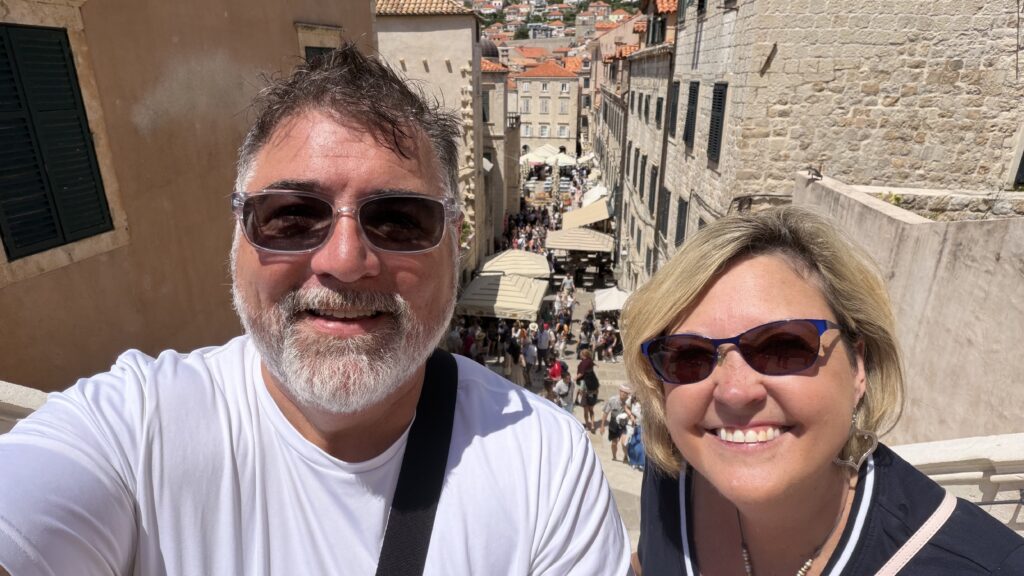
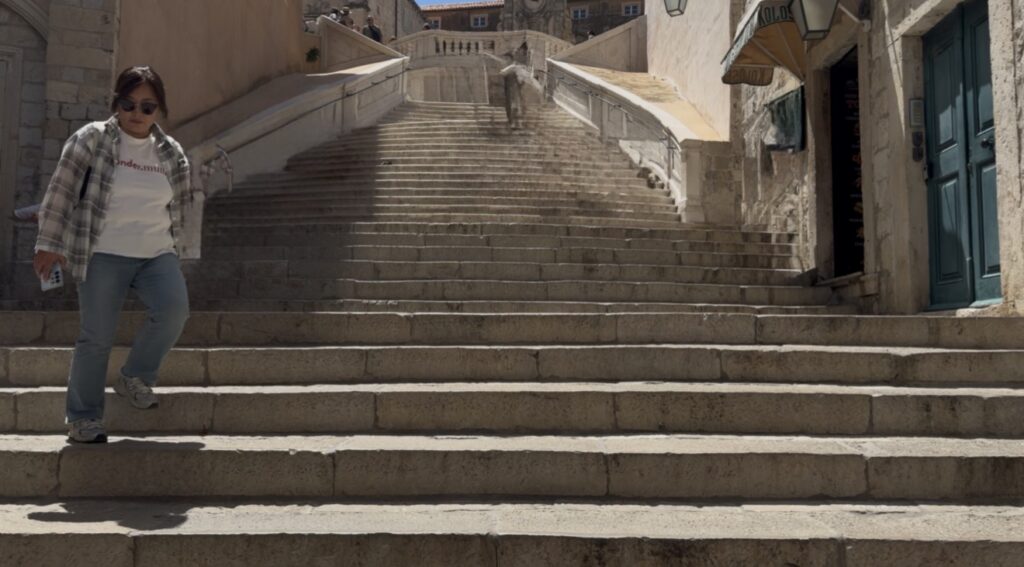
As the ship approaches Dubrovnik, the Old City slowly rises from the Adriatic like something preserved outside of time itself.
Massive stone walls stretch around red-tiled rooftops that have guarded this coastline for centuries.
From the water, Dubrovnik feels almost unreal.
Not because it looks artificial.
But because it looks enduring.
Empires rose and fell around this city.
Wars came and went.
Trade routes shifted.
And still these walls remain standing beside the sea.
There’s something deeply moving about places that survive history rather than simply witnessing it.
Pile Gate
Leaving the harbor behind, the route gradually climbs toward Pile Gate, the traditional entrance into Dubrovnik’s Old Town.
For generations, travelers crossed through this same entrance before stepping into one of the most carefully protected cities in the Mediterranean world.
Journeys often begin with thresholds like this.
Quiet transitions that separate one experience from another.
Passing through Pile Gate feels like stepping across centuries in a single moment.
Outside the walls, modern Croatia continues moving forward with traffic, buses, and cruise passengers.
Inside the walls, time seems to slow immediately.
Stone streets narrow.
Footsteps echo.
Shadows move across buildings shaped hundreds of years ago.
Dubrovnik doesn’t simply preserve history.
It surrounds you with it.
And maybe that’s why entering this city feels emotional in a way photographs never fully capture.
Stradun Reflection
As the city opens ahead, Stradun stretches through the center of Dubrovnik like a corridor connecting centuries together.
Walking along Stradun reveals the heartbeat of Dubrovnik.
For generations this street connected merchants, sailors, diplomats, travelers, and citizens living inside the protection of the walls surrounding them.
And even today, the city still feels deeply human.
Laundry hangs between buildings.
Conversations drift through narrow alleys.
Church bells echo above cafés and stone walkways.
Places like this remind me that history was never abstract.
It was daily life.
Ordinary people waking up, working, praying, struggling, celebrating, and continuing forward one day at a time.
And somehow that realization makes the city feel even more meaningful.
Onofrio’s Fountain
At the western end of Stradun stands one of the city’s most important historic gathering places.
Onofrio’s Fountain once supplied fresh water to the entire city through an engineering system that was remarkably advanced for its time.
In fortified cities like Dubrovnik, water meant survival.
And standing here reminds me how often unseen systems support visible strength.
That’s true historically.
And spiritually too.
The things sustaining us most deeply are often the things people around us never fully see.
Rector’s Palace
Continuing east through the city, the route gradually approaches the administrative center of the former Republic of Ragusa.
The Rector’s Palace reflects a different kind of power than many historic cities display.
Dubrovnik survived not primarily through conquest, but through diplomacy, wisdom, and careful leadership.
For centuries the republic balanced larger empires around it while preserving remarkable independence.
Standing here makes me think about how strength is not always loud.
Sometimes wisdom protects more effectively than force.
And honestly, that truth feels increasingly important in the world we live in now.
Dubrovnik Cathedral
Just beyond the palace, the cathedral rises quietly among the stone streets surrounding it.
Churches like this often become anchors for cities across generations.
Empires change.
Leadership changes.
Economies rise and fall.
But spaces of worship continue gathering people searching for hope, meaning, forgiveness, and peace.
There’s something comforting about that continuity.
Especially during seasons of transition.
Dubrovnik City Walls
Walking the city walls changes everything.
Suddenly the Adriatic stretches endlessly on one side while the rooftops of Dubrovnik fill the city below on the other.
Perspective changes from up here.
The streets that once felt crowded now look small.
The city that felt enclosed now feels connected to the wider sea beyond it.
And maybe that’s what perspective always does.
It doesn’t remove complexity.
It simply places it inside something larger.
Adriatic Reflection Point
From the cathedral square, the path begins rising toward one of the most extraordinary walking routes anywhere in Europe.
As the walk continues along the outer edge of the walls, the Adriatic opens wider toward the horizon beyond the city.
Standing above the Adriatic beside these ancient walls, it becomes clear why Dubrovnik mattered so much to travelers and empires alike.
Position shaped destiny here.
Trade routes.
Protection.
Influence.
Connection.
All of it depended on geography.
And sometimes our own lives work similarly.
Where we stand affects how we see.
How we think.
How we move forward.
That’s one reason travel can become transformational.
It changes position.
And changed position often changes perspective.
Sunset Over Dubrovnik
As evening approaches, sunlight begins softening across the stone walls and rooftops of the Old City.
Watching the light fade across Dubrovnik feels almost cinematic.
The stone glows warm gold before slowly cooling into evening shadows.
The Adriatic darkens into deep blue beyond the harbor.
And gradually the city begins becoming quieter.
Psalm 121 says,
“The Lord will watch over your coming and going both now and forevermore.”
Standing here above the city walls, those words feel especially meaningful.
Because places built for protection eventually remind us that true security has always come from something deeper than stone.
Closing Reflection
As the ship pulls away from Dubrovnik, the walls slowly begin shrinking back into the coastline behind us.
And what stays with me most is not simply the beauty of the city.
It’s the endurance.
The resilience.
The reminder that some places survive because they learned how to balance strength with wisdom across generations.
Maybe sabbatical is teaching something similar.
Not simply how to rest.
But how to endure wisely.
And perhaps that’s one of the most valuable journeys a person can take.