Adriatic Sail Into Zadar
As the ship approaches Zadar, the coastline feels quieter than many of the other ports along the Adriatic.
There are no towering cliffs like Santorini.
No massive walls rising dramatically from the sea like Dubrovnik.
Instead, Zadar welcomes visitors slowly.
Stone streets.
Bell towers.
Roman ruins.
Open waterfront promenades.
And a rhythm shaped more by everyday coastal life than spectacle.
But sometimes quieter places reveal themselves more deeply over time.
And honestly, Zadar feels like that kind of city.
Walk Toward the Land Gate
Leaving the harbor area behind, the route moves toward the historic Land Gate, the traditional entrance into the Old Town.
For centuries travelers crossed through this same gateway while entering one of the Adriatic’s most important Venetian coastal cities.
Journeys often begin with simple transitions like this.
A gate.
A bridge.
A shoreline.
And suddenly the atmosphere changes.
Land Gate Reflection
Passing through the Land Gate feels like stepping into layers of history quietly stacked together.
Venetian architecture blends with Roman foundations.
Church towers rise beside cafés.
Modern life continues naturally among structures that have stood here for centuries.
What strikes me most about places like Zadar is how unforced the history feels.
Nothing here seems staged.
The city simply continues living beside its own past.
Roman Forum
From the gate, the streets gradually open into one of the oldest public spaces in the city.
The Roman Forum dates back nearly two thousand years and once served as the civic center of ancient Zadar.
Standing among these ruins reminds me how many ordinary lives unfolded here long before modern travelers ever arrived.
Conversations.
Markets.
Politics.
Worship.
Daily routines repeated generation after generation.
History is often closer than we realize.
Not distant.
Not abstract.
But layered directly beneath the places we still walk today.
Transition — Walk Toward St. Donatus
Church of St. Donatus
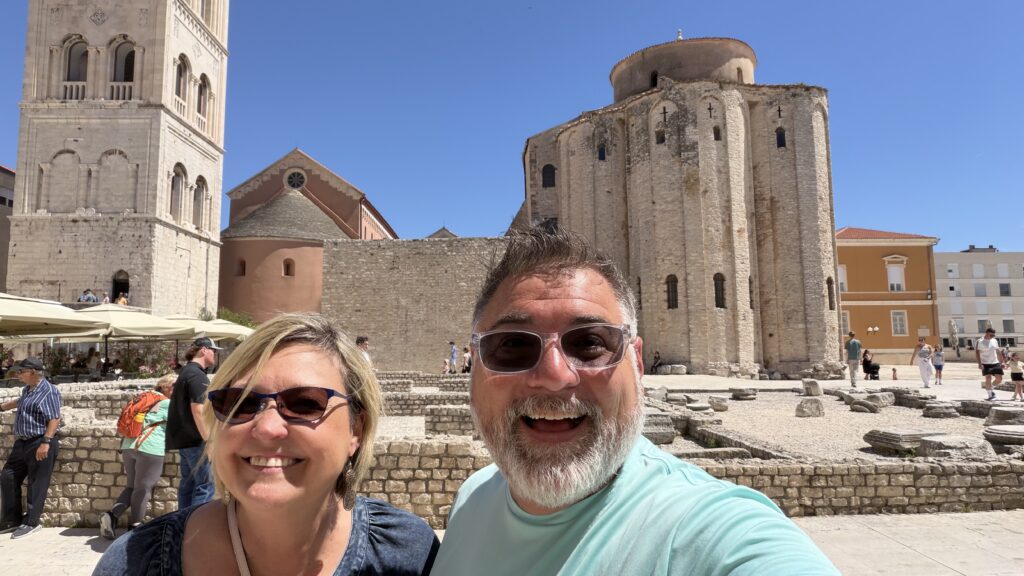
Beside the forum stands one of the most recognizable landmarks in Croatia.
The circular Church of St. Donatus has stood here since the ninth century and remains one of the most important examples of early medieval architecture along the Adriatic.
Its shape immediately captures your attention.
But what feels even more remarkable is its endurance.
Empires changed around it.
Borders shifted.
Wars came and went.
And still this church remains standing beside the forum after more than a thousand years.
Faith communities often outlast the eras surrounding them.
And maybe that quiet consistency is part of their strength.
Transition — Walk Toward Cathedral of St. Anastasia
Just beyond St. Donatus rises the cathedral bell tower overlooking the Old Town.
Cathedral of St. Anastasia
The Cathedral of St. Anastasia reflects centuries of worship woven into the life of this city.
Places like this remind me how belief often becomes part of a community’s foundation rather than something separate from it.
People prayed here through prosperity and hardship.
Through uncertainty and peace.
Generation after generation continuing forward together.
There’s something deeply stabilizing about places that hold memory like that.
Transition — Walk Toward the Waterfront
Leaving the historic center behind, the streets gradually open toward the sea once again.
The Sea Organ
The Sea Organ may be one of the most unique places anywhere along the Adriatic coast.
Hidden beneath the waterfront steps are pipes designed to transform waves into music.
No performance schedule.
No musician visible.
Only wind.
Water.
And sound created naturally by the movement of the sea itself.
Standing here reminds me how creation often communicates in ways more powerful than words.
Sometimes beauty doesn’t need explanation.
It simply needs attention.
Walk Toward the Sun Salutation
Just beyond the Sea Organ stands another modern installation shaped by interaction with nature itself.
Greeting to the Sun
The Sun Salutation gathers solar energy during the day before transforming it into patterns of light across the waterfront after sunset.
What fascinates me about Zadar is how naturally ancient history and modern creativity exist together here.
Roman ruins stand beside contemporary art.
Medieval churches overlook innovative installations.
And somehow none of it feels disconnected.
Instead, the city feels layered.
Alive.
Still evolving.
Transition — Sunset Along the Adriatic
Stop 7 — Adriatic Sunset Reflection
As evening approaches, the light across the Adriatic begins softening while people gather along the waterfront waiting for sunset.
Alfred Hitchcock once reportedly called Zadar’s sunset the most beautiful in the world.
Standing here as the sun lowers into the Adriatic, it becomes easier to understand why.
The horizon stretches endlessly.
The Sea Organ echoes softly behind you.
And gradually the entire waterfront becomes quieter.
Psalm 19 says,
“The heavens declare the glory of God; the skies proclaim the work of His hands.”
Moments like this make those words feel immediate rather than symbolic.
Creation has a way of slowing us down long enough to notice what matters most.
Closing Reflection — Return Toward Ship
As the harbor lights begin reflecting across the water, Zadar slowly fades into evening behind the ship.
And what stays with me most about this city is not dramatic spectacle.
It’s balance.
The balance between history and modern life.
Between creativity and stillness.
Between movement and reflection.
Maybe that’s part of what sabbatical is teaching too.
Not simply how to stop.
But how to live with better rhythm moving forward.